
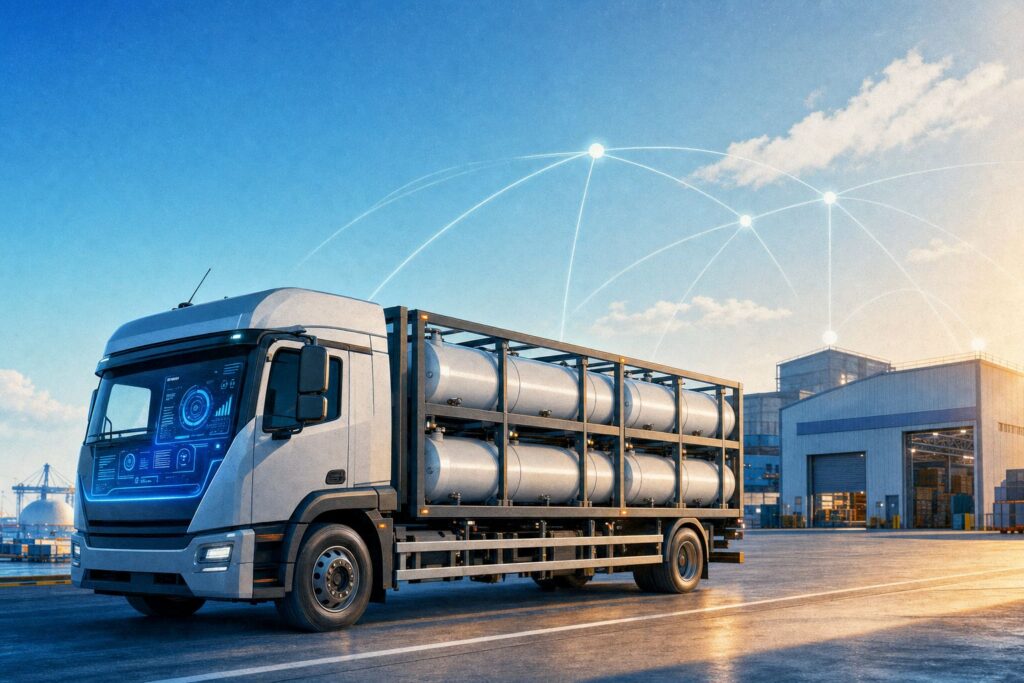
How to Choose Delivery Software for LPG and Bulk Gas Operations
The LPG delivery management market is at a structural turning point. According to PRNewswire, the global LPG management systems market is projected to reach $802.5 million by 2026 – a figure that reflects accelerating investment across the sector as distributors replace manual processes with automated platforms. For LPG distributors managing bulk tankers, cylinder networks, and customer tank assets in parallel, that investment calculus is straightforward: the question is not whether to adopt LPG delivery software, but which type matches the complexity of your operation.
Delivery software has become core infrastructure for LPG and bulk gas distributors. Modern platforms deliver route optimization that cuts fuel consumption by 20-25%, automated compliance workflows aligned with NFPA 58 and tightening safety standards, and real-time visibility across bulk, cylinder, and tank operations. The right solution generates ROI within 60-90 days for small-to-mid fleets while eliminating manual dispatch overhead and enabling customer self-service ordering. Choosing between a full integrated ERP and a specialized dispatch tool comes down to one question: do you manage a complete distribution chain, or logistics optimization alone?
Table of contents
Why LPG Delivery Software Matters for LPG Distributors
What Must LPG Delivery Software Handle?
Solution Types: From Full ERP to Specialist Platforms
Essential Features for LPG Operations
What ROI Should You Expect from LPG Delivery Software?
FAQs: Your Fuel Delivery Software Questions
Making Your Selection: A Decision Framework
Why LPG Delivery Software Matters for LPG Distributors
LPG distribution operates under a combination of pressures that generic freight or fuel oil delivery software rarely addresses: regulatory intensity across safety and compliance standards, multi-format operations spanning bulk, cylinder, and fixed tank networks, and margin environments where route inefficiency compounds rapidly across thousands of deliveries per year.
The compliance layer is growing more demanding. In 2026, the propane industry faces tighter safety standards, improved leak detection requirements, mandatory digital documentation, NFPA 58 compliance obligations, cathodic protection requirements, and corrosion monitoring mandates, according to BP News. Manual paper-based processes cannot absorb that regulatory load at scale without generating compliance gaps.
The operational case is equally clear. A distributor running 15 trucks on manual dispatch is working with routing that achieves 60-75% efficiency at best compared to algorithm-optimized alternatives, according to Nectar Bits. The gap between what manual routing delivers and what a properly configured platform produces translates directly to fuel costs, labor hours, and vehicle utilization per shift.
What Must LPG Delivery Software Handle?
Answering this question accurately for LPG distribution reveals why platform selection is more consequential here than in other fuel sectors.
At the logistics layer, the core requirement is dispatch and route optimization. Platforms using real-time traffic data, vehicle capacity constraints, and delivery window rules reduce daily route duration by 45-60 minutes per driver and add one additional delivery per route on average, according to ZEO Route Planner (2026). Over a full fleet, that compounds into substantial capacity recovery without adding vehicles.
Beyond logistics, LPG operations introduce requirements that general dispatch platforms cannot fulfill. Temperature-corrected volume calculations are mandatory for bulk billing: delivering LPG in varying ambient conditions requires applying correction factors to ensure accurate invoicing. Cylinder tracking must operate at the individual asset level – by brand, format, and deposit status – across all customer accounts. Tank asset management demands records of ownership, contract type, inspection schedules, and maintenance history for every unit in the field.
Driver workflows need to enforce mandatory visual safety checks at the point of delivery – not optional form fields a driver can skip, but enforced gate steps that generate time-stamped, auditable records. And customer-facing operations benefit from a self-service portal that gives account holders direct access to order history, invoices, and delivery status, reducing inbound call volume without degrading service quality.
Proof-of-delivery capture, signature workflows, and real-time vehicle tracking complete the picture. A platform that handles all of these natively – rather than requiring custom integrations to patch together separate point solutions – delivers a fundamentally different level of operational coherence.
Solution Types: From Full ERP to Specialist Platforms
The LPG delivery software market organizes into four broad categories, each serving a different operational profile.
Full integrated ERP systems address the complete distribution chain from order entry through invoicing, compliance, and customer account management. They centralize commercial, operational, and regulatory data in a single environment. For distributors managing bulk, cylinder, and tank operations simultaneously, an ERP eliminates the data fragmentation that arises when separate systems cannot communicate in real time. Implementation is more involved than point solutions, but the result is a single source of truth across every operational dimension.
Dispatch and transportation management platforms focus on the logistics layer: scheduling, route optimization, driver assignment, and proof of delivery. They integrate with external billing or ERP systems but do not manage compliance workflows, tank asset records, or customer account portals natively. For operations whose primary constraint is logistics throughput rather than multi-module integration, a TMS offers a faster path to measurable gain.
Route optimization tools are point solutions for scheduling efficiency alone. They generate returns quickly and at lower entry cost, but they require adjacent systems for billing, compliance, and asset management – creating integration work that accumulates over time. Entry-level and niche solutions serve low-volume distributors with basic scheduling needs; they are accessible by cost but limited in scalability and compliance depth.
Comparing Your Options
Mapping solution types against actual LPG operational requirements reveals where each category falls short.
| Capability | Full ERP | TMS + Dispatch | Route Optimizer | Entry-level |
|---|---|---|---|---|
| Bulk volume temperature correction | Native | Rare | No | No |
| Cylinder deposit tracking | Native | No | No | No |
| Tank asset management | Native | No | No | No |
| Safety check enforcement | Native | Partial | No | No |
| Customer self-service portal | Native | Rare | No | No |
| Route optimization | Integrated | Core | Core | Basic |
| Billing and invoicing | Native | Via integration | No | Partial |
| Regulatory audit trails | Native | Partial | No | No |
Implementation timelines vary by solution type. Route optimization tools can go live in days. TMS implementations run 4-8 weeks. Full ERP deployments for mid-to-large LPG operations involve data migration, configuration, and training that commonly span 3-6 months – but deliver a platform stable enough to run unchanged for years. For operations where compliance continuity matters, that investment in implementation depth pays dividends over the long run.
Scalability and integration potential follow a similar pattern. TMS and route optimizer solutions are lighter to connect with existing billing or accounting systems. Full ERPs require more upfront technical alignment but reduce long-term integration maintenance once all operational data flows through a single environment.
Essential Features for LPG Operations
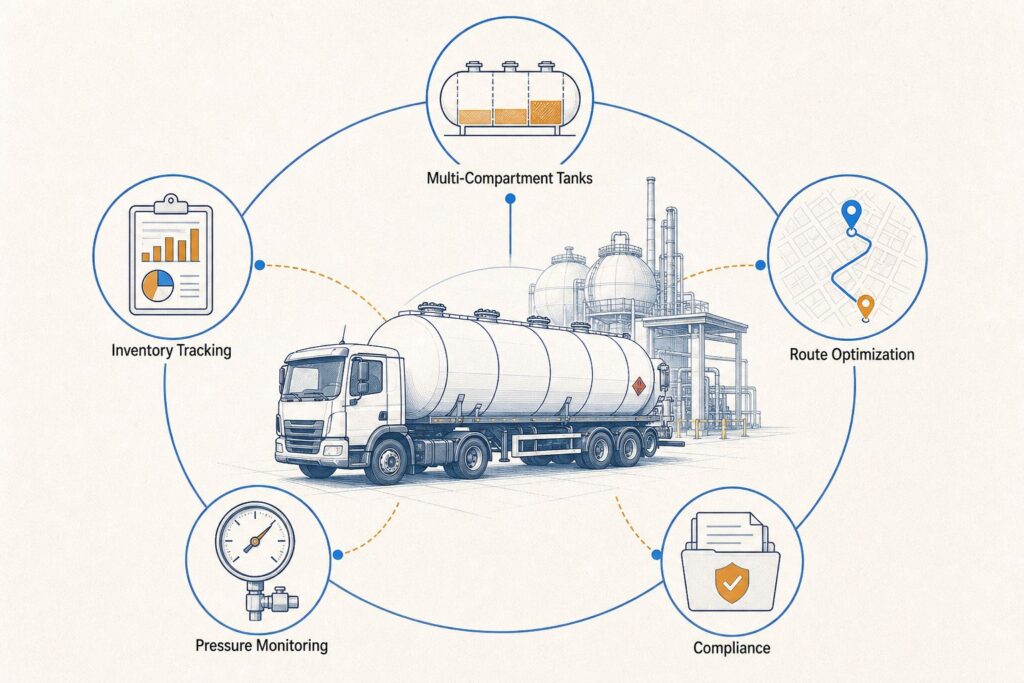
Not every platform that claims LPG compatibility delivers the specificity the sector actually demands. Five capabilities separate genuinely domain-native platforms from generic tools adapted to LPG.
Multi-compartment tank management needs to handle ownership records, contract types, mandatory inspection dates, and maintenance history per asset. Running thousands of tanks across a customer network on spreadsheets or a generic field service tool generates record gaps that carry real compliance and operational risk.
Compliance automation must cover mandatory safety check sequences tied to NFPA 58, leak detection event logging, cathodic protection monitoring, and the mandatory digital documentation required under 2026 regulatory standards. Platforms that enforce these workflows at the driver level – rather than relying on post-delivery paperwork – produce defensible audit trails without adding administrative overhead.
Driver mobile workflows must enforce, not just offer, mandatory inspection sequences. Time-stamped photo and signature capture synchronized in real time to the back office transforms a compliance obligation into an operational byproduct rather than an administrative burden.
Billing integration that handles the specific logic of LPG – kilogram-to-litre conversions, temperature-corrected bulk volumes, deposit management, cylinder exchange billing – must be native or supported via structured integration with the existing accounting environment. Workarounds that live in spreadsheets outside the core system accumulate as long-term operational liabilities.
Regulatory documentation must be generated automatically through normal delivery workflows, not assembled after the fact from fragmented records. In a sector where a compliance failure can trigger operational disruption, the difference between a platform that produces audit-ready records as a byproduct and one that requires manual compilation is not a minor detail.
What ROI Should You Expect from LPG Delivery Software?
The financial returns from delivery software are measurable, fleet-size-dependent, and front-loaded toward route efficiency.
The most immediate gains come from dispatch optimization. Route optimization cuts fuel consumption by 20-25% and compresses daily route duration by 45-60 minutes per driver, enabling one additional delivery per route on average, according to ZEO Route Planner (2026). Each additional delivery per driver per day represents incremental revenue at zero additional vehicle cost.
The scale of financial return varies with fleet size. For small operations of 10-15 trucks, well-configured dispatch generates $4,000-6,000 in monthly savings with a 60-90 day ROI payback period. For enterprise-scale operations, documented ROI ranges from $85,000 to $186,000 annually, achieved within 7-12 months of deployment.
Implementation costs, training, and data migration all affect the true payback timeline. Platforms built from the ground up for LPG distribution reach operational readiness with less configuration work than generic tools adapted to the sector, which reduces implementation cost relative to delivered capability. The more durable financial argument is long-term platform stability: a system that runs the same core workflows for a decade without re-platforming eliminates the hidden cost of repeated implementation cycles that point-solution stacks accumulate over time.
FAQs: Your LPG Delivery Software Questions
The market splits into four categories: full integrated ERP systems covering the complete distribution chain, transportation management platforms focused on dispatch and route logistics, route optimization tools addressing scheduling efficiency alone, and entry-level solutions for small fleets. For LPG distributors managing bulk, cylinder, and tank operations simultaneously, integrated ERP platforms are the only category that handles all required workflows natively without significant adjacent integration work.
Pricing varies substantially by solution type and scale. Route optimization tools typically charge per vehicle per month at relatively low cost. Transportation management platforms price on active users or vehicle count and add integration services. Full ERP systems for LPG distribution involve license or subscription fees plus implementation services, but the total cost of ownership comparison over a 5-10 year horizon needs to account for the integrations, workarounds, and re-implementation cycles that point solutions accumulate.
he answer depends on the scope of your operation. If your core constraint is logistics scheduling for a straightforward delivery fleet, a TMS or route optimizer delivers faster results at lower upfront cost. If you manage bulk operations, cylinder deposit networks, tank asset portfolios, and compliance obligations simultaneously, a full ERP eliminates the data fragmentation that point solutions generate – and that fragmentation carries both operational and compliance costs that are easy to underestimate.
Small fleets of 10-15 trucks report $4,000-6,000 in monthly savings with 60-90 day payback periods. Enterprise operations document $85,000-186,000 in annual ROI within 7-12 months. Fuel cost savings from route optimization – a 20-25% reduction in fuel consumption – typically arrive first, followed by labor efficiency gains from shorter route durations and reduced compliance overhead from automated workflows.
NFPA 58 compliance workflows, mandatory safety check enforcement at the driver level, leak detection event logging, mandatory digital documentation now required under 2026 regulatory standards, cathodic protection tracking, and automatic audit trail generation as a byproduct of normal operations form the non-negotiable baseline. A platform that cannot enforce these workflows at the point of delivery shifts compliance risk back to the distributor.
Most platforms offer integration paths for accounting systems, ERP backends, and telematics. The critical distinction is whether the integration is native – designed into the platform – or requires custom middleware. Full ERP systems built specifically for LPG distribution manage most operational data internally, reducing long-term integration maintenance compared to point-solution stacks that depend on multiple external connections.
Making Your Selection: A Decision Framework
LPG distributors sit on a spectrum of operational complexity, and the right platform maps directly to your position on that spectrum.
Define your operational scope before evaluating any product. A distributor running bulk truck deliveries to industrial accounts has different requirements than one managing bulk tankers, cylinder exchange routes, and a residential tank network with thousands of monitored assets. The second profile generates operational and compliance gaps when served by logistics-only platforms – gaps that become more expensive to close as the business scales.
Prioritize specialization over feature breadth. A platform built from the ground up for LPG distribution handles domain-specific requirements – temperature correction, deposit tracking, mandatory inspection enforcement – as native functions developed and tested against real operational conditions. A generic platform adapted to the sector handles them as configurations or workarounds. The practical difference shows in implementation time, ongoing support requirements, and how the software responds when regulations change.
Before committing to any solution, work through a structured evaluation:
- Does the platform calculate temperature-corrected bulk volumes natively?
- Does it enforce mandatory safety check sequences rather than offering optional fields?
- Does it track cylinder deposits by brand, format, and customer account?
- Does it maintain tank asset records with contract type, inspection dates, and maintenance history?
- Does it include a customer self-service portal that reduces inbound call volume?
- What is the vendor’s documented history in LPG distribution specifically?
Platform longevity is a selection criterion that gets underweighted in feature-focused comparisons. A vendor with LPG-specific development history spanning more than two decades, and customers who have run the same core platform through organizational changes and regulatory cycles, offers a risk profile that generalist alternatives cannot match.
For distributors who view software as long-term operational infrastructure rather than a replaceable tool, that track record is not a soft differentiator – it is a hard operational guarantee.