
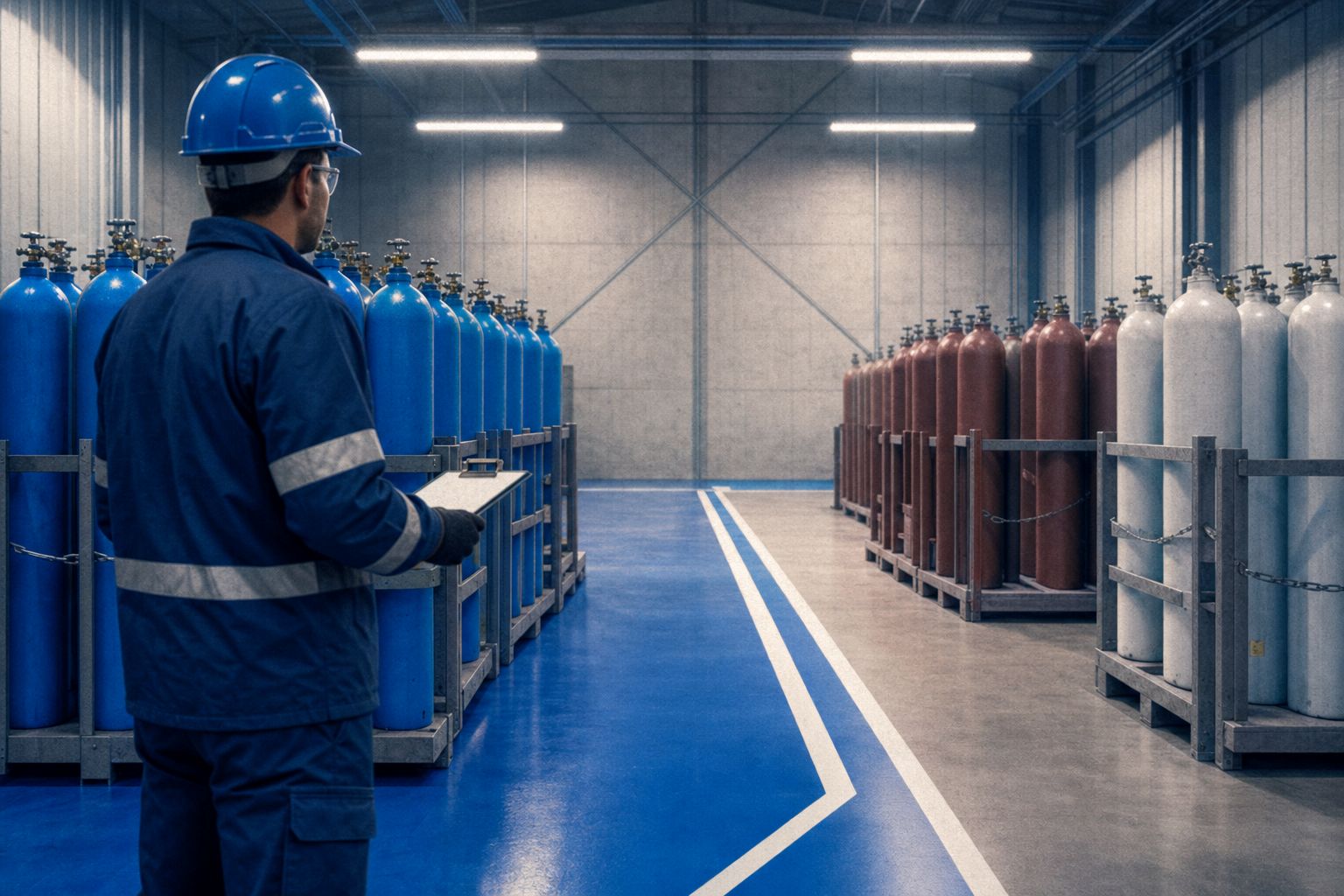
Gas Cylinder & LPG Storage Requirements: OSHA (US) and European Standards
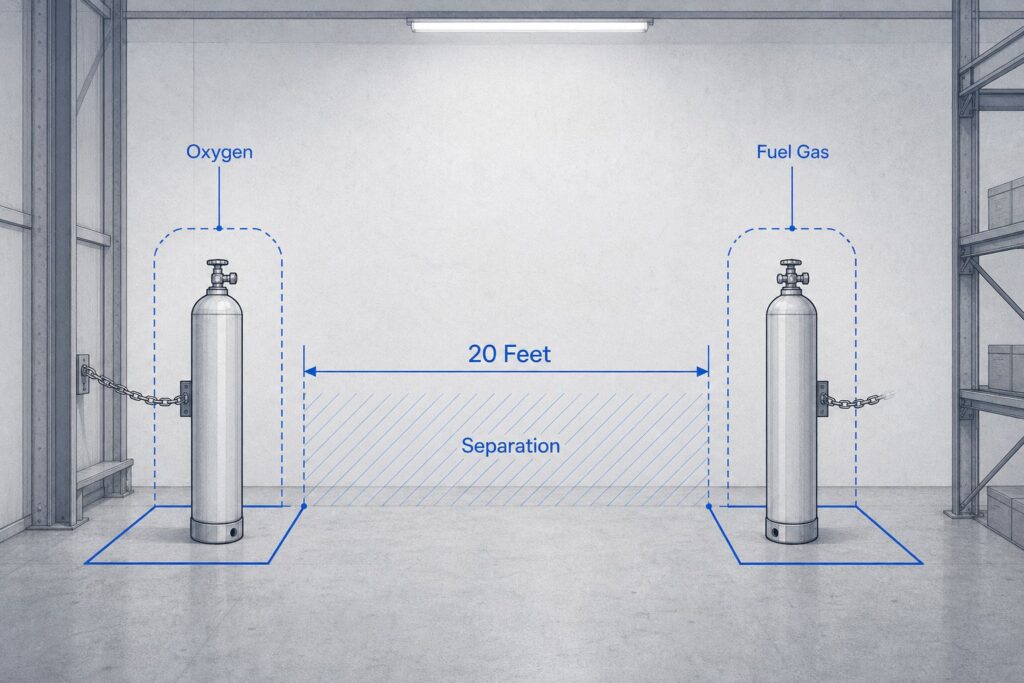
Both US federal regulations (OSHA 1910.101, 1910.253, 1926.350) and the European regulatory framework (ATEX Directives, SEVESO III, CLP Regulation, and local environmental codes) mandate that compressed gas cylinders be stored in dry, well-ventilated areas protected from heat sources. Oxygen must be strictly separated from flammable gas cylinders by a minimum distance (6 meters / 20 feet under OSHA; 5 meters under EU standards) or by a certified fire-rated barrier.
For LPG distributors and industrial gas suppliers managing multiple storage locations and diverse cylinder types, compliance is both a legal obligation and an immediate operational priority. Organizations that translate these mandates into documented procedures and routine site audits significantly reduce regulatory exposure and handle safety inspections with measurable confidence.
Table of Contents
- Understanding the Regulatory Frameworks (OSHA vs EU)
- Location and Environmental Requirements for Safe Storage
- Separation Rules: Oxygen vs Flammable Gases (Propane, Acetylene)
- Restraint, Positioning, and Mechanical Protection
- Cylinder Labeling & Color Coding: OSHA vs CLP / EN 1089-3
- Common OSHA/EU Violations and Regulatory Consequences
- How LPG Distributors Systematize Multi-Site Compliance
- US vs Europe Comparison Summary Table
- Frequently Asked Questions
Understanding the Regulatory Frameworks (OSHA vs EU)
The US Framework (OSHA & CGA)
OSHA’s rules for compressed gas cylinders primarily stem from 1910.101 (general handling and hazard communication) and 1910.253 (oxygen-fuel gas welding and cutting). Standard 1910.101 incorporates by reference the Compressed Gas Association’s CGA Pamphlet P-1-1965. This incorporation gives federal inspectors the authority to issue citations based directly on CGA technical specifications, even when those specifics are not fully detailed in the federal regulatory text itself.
The European and UK Framework
In Europe, cylinder storage is governed by a set of directives transposed into national laws (such as the DSEAR/HSE regulations in the UK or ICPE in France):
- ATEX Directives (1999/92/EC & 2014/34/EU): Mandates explosion risk assessments, hazardous area classification (Zone 1, Zone 2), and certified explosion-proof equipment.
- PED Directive 2014/68/EU: Regulates pressure equipment design and safe operational thresholds.
- CLP Regulation (EC No 1272/2008): Harmonizes classification, labeling, and packaging of hazardous chemicals using GHS pictograms.
- National Environmental & Labor Codes: Require registration, authorization, or notification based on total tonnage stored, alongside strict boundary distances from third-party properties.
Location and Environmental Requirements for Safe Storage
Ventilation Standards & Explosion Prevention
- United States (OSHA): Storage in unventilated enclosures (cabinets, unvented closets, or sealed rooms) is strictly prohibited. Ventilation must prevent gas accumulation in the event of minor leaks.
- Europe: Storage must ideally be outdoors or under a heavily ventilated shelter. Because propane and butane are heavier than air and settle at ground level, low-level floor ventilation is mandatory. For indoor storage, employers must issue an Explosion Protection Document (EPD/DRPE) defining ATEX zones and installing spark-proof electrical equipment.
Temperature Limits
- OSHA: Sets a strict maximum ambient storage temperature of 125 °F (52 °C).
- Europe: The standard design threshold for pressure vessels (PED Directive) caps the maximum allowable storage temperature at 50 °C (122 °F). Cylinders must be protected from direct solar radiation and away from boilers, radiators, or steam lines.
Separation Rules: Oxygen vs Flammable Gases
Because oxygen dramatically accelerates combustion, separating oxygen cylinders from fuel gases (propane, butane, acetylene, hydrogen) is subject to strict distance parameters:
          AMERICAN CONVENTION (OSHA)                        EUROPEAN CONVENTION (EU)
 ┌──────────┐   20 feet (6 m)    ┌──────────┐    ┌──────────┐  5 meters min.  ┌──────────┐
 │  Oxygen  │ <────────────────> │ Propane/ │    │  Oxygen  │ <─────────────> │ Propane/ │
 │          │   OR 5 ft Wall     │ Acetyl.  │    │          │  OR EI 120 Wall │ Acetyl.  │
 └──────────┘                    └──────────┘    └──────────┘                 └──────────┘
- Under OSHA Rules:
- Minimum horizontal distance of 20 feet (6 meters).
- Alternative: A fire-resistant barrier at least 5 feet (1.5 meters) high with a non-combustible fire resistance rating of at least 30 minutes.
- Under European Standards:
- Recommended/mandated horizontal separation of 5 meters (16.4 feet) minimum.
- Alternative: A certified EI 120 fire wall (2-hour fire resistance rating) extending at least 0.5 meters above the tallest cylinder.
Restraint, Positioning, and Mechanical Protection
Physical control measures remain virtually identical across international borders:
- Vertical Position & Securing: Cylinders must be stored upright and secured (chains, straps, or dedicated racks) to prevent tipping or falls that could shear off the valve assembly.
- Valve Protection Caps: Must remain firmly in place whenever cylinders are not actively connected for use (OSHA 1910.101 and TPED / ADR transport safety regulations in Europe).
- Acetylene Specifics: Must always be stored valve-end up to prevent the liquid solvent (acetone) inside the porous mass from entering the valve.
Cylinder Labeling & Color Coding: OSHA vs CLP / EN 1089-3
Labeling requirements represent one of the most significant differences between US and European operations:
                      CYLINDER IDENTIFICATION STANDARDS
 ┌──────────────────────────────────────┬──────────────────────────────────────┐
 │           OSHA STANDARD (US)         │         EUROPEAN STANDARD (EU)       │
 ├──────────────────────────────────────┼──────────────────────────────────────┤
 │ • Stencil / written label mandatory  │ • CLP GHS hazard label mandatory     │
 │ • Color coding not standardized      │ • Color-coded shoulder mandatory     │
 │ • Written text overrides color       │   under EN 1089-3                    │
 └──────────────────────────────────────┴──────────────────────────────────────┘
- United States (OSHA): Stenciled or written hazard labels take absolute priority (OSHA 1910.1200 HazCom). Supplier color coding is not standardized by federal law and cannot replace written markings.
- Europe:
- CLP Regulation (EC 1272/2008): Labels must feature standard GHS pictograms (flame, gas cylinder, oxidizer), signal words, and hazard statements.
- EN 1089-3 Standard: Color coding on the cylinder shoulder (ogive) is mandatory and standardized across the EU (e.g., Red = Flammable/LPG/Hydrogen, White = Oxygen, Yellow = Acetylene).
US vs Europe Comparison Summary Table
| Compliance Factor | US Standards (OSHA / CGA) | European Standards (EU / UK) |
| Oxygen / Fuel Separation | 20 ft (6 m) or 5 ft fire wall (30-min) | 5 meters or EI 120 fire wall (2-hour) |
| Max Ambient Temperature | 125 °F (52 °C) | 122 °F (50 °C) (PED Directive) |
| Explosion Protection | NEC / NFPA Class I, Div 1/2 | ATEX Directive 1999/92/EC (Zone 1, Zone 2) |
| Visual Identification | Written HazCom text label | CLP GHS Label + EN 1089-3 shoulder color |
| Site Regulation | NFPA 58 / Local Fire Codes | SEVESO III / Environmental Protection Acts |
How LPG Operators Systematize Multi-Site Compliance
For LPG distributors operating across multiple territories, maintaining uniform compliance relies on digitalization and standardized operational frameworks:
- Unified Standard Operating Procedures (SOPs): Draft site SOPs adhering to the strictest applicable threshold (e.g., 20-foot separation, ATEX zone mapping, and dual CLP/OSHA labeling checks).
- Digital Inspection Logs: Deploy mobile asset management platforms to execute digital site checklists (valve checks, cap placement, label legibility, and fire-wall integrity).
- Audit Readiness: Maintain centralized, auditable records to demonstrate good-faith compliance during unannounced OSHA inspections in the US or Environmental/Labor Agency visits in Europe.
Frequently Asked Questions
No. Under OSHA rules, the barrier must be non-combustible with at least a 30-minute fire-resistance rating and 5 feet high. In Europe, the wall must meet EN 13501-2 standards (typically an EI 120 rating for 2 hours of resistance) and extend above the height of the cylinders.
Strictly prohibited in Europe and severely restricted/discouraged under US fire codes. Because propane and butane are denser than air, leaking gas pools in low points, creating severe explosion and asphyxiation hazards.
No. US cylinders do not follow the EN 1089-3 European color-coding standard. Any cylinder imported or operated within European jurisdictions must be relabeled under the CLP regulation and feature the correct standardized shoulder color.